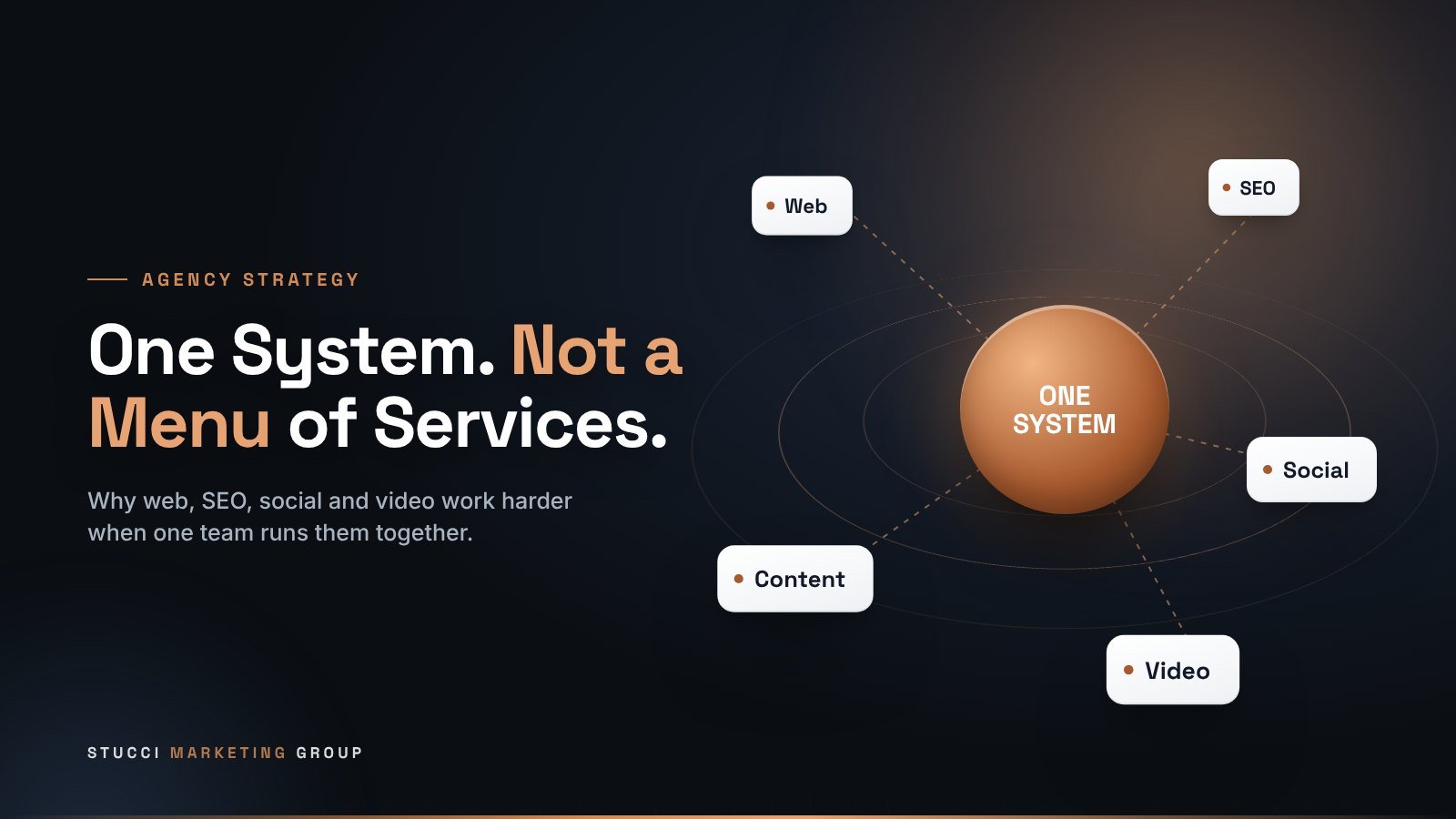
We run Stucci Marketing Group as one integrated system rather than a menu of services because marketing results come from how the pieces connect, and a menu sells you pieces. When your website, SEO, content, and social are each handled by someone who has never seen the others, nobody owns the outcome — everyone owns their slice, and the gaps between slices are where results go to die.
Most businesses don’t choose the patchwork model. They arrive at it by accident: a freelancer for the website, a different one for SEO, an agency for social, a cousin’s friend for the logo. Every piece gets built by someone who’s never seen the other pieces. Then everyone wonders why the brand feels disjointed and the results feel scattered.
That’s the model we specifically don’t run. Here’s the reasoning, including where it doesn’t apply.
The Problem With a Vendor Patchwork
When four different people handle four different channels and none of them talk to each other, the failure isn’t incompetence. Each vendor may be genuinely good. The failure is structural: every one of them is optimizing for a goal that is narrower than yours.
The web developer optimizes for a clean launch, not for what the SEO strategy needs six months later. The social content doesn’t reflect what’s actually converting on the site. Nobody’s watching the full customer journey, because nobody’s responsible for the full customer journey — only their one piece of it.
The result is marketing that looks fine in pieces and doesn’t add up to anything as a whole. Worse, it’s marketing where nobody can tell you why it isn’t working, because the answer lives in the space between two contracts.
Where the gaps actually open up
These are the specific seams that split, over and over, in a multi-vendor setup:
- Site structure versus search strategy. The site gets built around a navigation the designer liked. Then the SEO plan needs pages, hierarchy, and internal linking that structure can’t support, so the “SEO work” becomes a permanent argument with the site’s architecture.
- Content written blind. The content vendor writes to a keyword list. The keyword list was built without knowing which services actually carry margin, which leads the sales side can close, or which pages already convert.
- Social disconnected from the offer. Social builds an audience around whatever performs, and the audience it builds has no relationship to what the business sells. Reach goes up. Revenue doesn’t.
- Tracking that nobody owns. Analytics and conversion tracking get installed by whoever was there first, then break silently during a redesign. Three months of data is gone, and no vendor considers it their fault — reasonably, since it wasn’t in anyone’s scope.
- Brand drift. Four vendors making small, defensible aesthetic and tonal decisions produce a brand that reads as four different companies.
Every one of those is a handoff failure, not a skill failure. You cannot fix a handoff failure by hiring a better vendor for one side of the handoff.
Who Ends Up Doing the Integration Work
Here’s the part that rarely makes it into the pitch: in a patchwork, the integration work still has to happen. Someone has to brief four vendors, reconcile their conflicting recommendations, notice that the new site broke the tracking, and decide whose advice wins when the SEO vendor and the developer disagree.
That someone is the business owner. It’s unpaid, unscheduled, and it’s the job they’re least equipped to do, because it requires knowing enough about all four disciplines to referee them. So it mostly doesn’t get done — and the default resolution is that whichever vendor is loudest sets the direction.
The honest way to price a multi-vendor marketing stack is to add the owner’s hours as a line item. Once you do, the apparent savings usually disappear.
What “One System” Actually Means
Running strategy, creative, web, SEO, and content as one integrated system means the same team that writes your content knows what your SEO strategy is targeting. The same team that built your website is the one watching what converts and feeding that back into the ad and social strategy. Nothing gets built in a vacuum, because everything is built to work with everything else. It’s the model behind our work as a Southwest Florida marketing agency: one team, one plan, one set of numbers.
In practice, that looks like:
- Strategy comes first, and every deliverable — web, content, video, social — ties back to it, instead of existing as a disconnected one-off project
- One team holds the full picture, so nothing falls into the gap between two vendors who each assume the other is handling it
- Data flows back into decisions — what’s working on the site shapes the content plan, what’s converting shapes the ad spend
- Manufacturing-grade process discipline (documented steps, weekly check-ins, clear timelines) applied to something most agencies treat as loose and improvisational
Why the process discipline matters more than the creative
That last point is the one people underestimate, and it’s where two decades on manufacturing floors — Lockheed Martin, 3M, aerospace — changes how this gets run. On a production line, you don’t get to be inspired. You get a documented process, defined handoffs, a measurement at each step, and a standing review where the numbers either moved or they didn’t.
Marketing almost never gets treated that way, which is why so much of it is unaccountable. Applying Lean Six Sigma thinking to a marketing operation mostly means two things: find the waste, and make the handoffs explicit. Waste is the content nobody reads, the redesign that resets your search equity, the report nobody can act on. Explicit handoffs are what keep a strategy intact between the person who set it and the person executing it. Neither one requires creative genius. Both require someone accountable for the whole line.
Why This Matters More Than the Individual Services
The individual capabilities — building a website, running SEO, producing content — aren’t unique. Plenty of people can do each of those things competently on their own. What’s actually differentiating is having one accountable team that sees the whole system and is responsible for how all the pieces work together, instead of a business owner playing project manager between four vendors who’ve never spoken to each other.
Put differently: the value isn’t in any single service. It’s in the compounding you only get when they’re coordinated. A site built to support the search strategy makes the SEO cheaper. Content written against what converts makes the social feed relevant. Social that understands the offer feeds qualified traffic into a site engineered to handle it. Each piece raises the ceiling on the others — and a patchwork forfeits all of it by default.
That’s the whole premise behind how we operate: not a menu of services to pick from, but one integrated growth engine your business plugs into.
When a Single Specialist Is the Right Call
This isn’t an argument that integration always wins. It doesn’t, and pretending otherwise would be the same overselling we’re describing. A single specialist is the better buy when:
- You genuinely have one isolated problem. One landing page, one logo, one broken checkout. Buying a system to solve a discrete task is overkill.
- You already have the integration function in-house. If you have a marketing lead who sets strategy and owns the whole funnel, specialists executing against that strategy is a perfectly sound model — that person is doing the coordinating.
- The requirement is deeply technical and narrow. Some problems want a specialist who does nothing else.
- You’re pre-strategy. If you don’t yet know who you sell to or what you sell them, buying execution of any kind is premature. Fix that first.
The integrated model earns its keep when the problem is growth rather than a task, when nobody internally owns the whole funnel, and when the pieces you already have don’t work together.
How to Tell Whether an Agency Actually Runs One System
Every agency now claims to be integrated. “Full service” appears on nearly every website in this industry, and it frequently means the same team of subcontractors reached through one invoice. A few questions cut through it quickly:
- Who sets the strategy, and will I speak to them again? If strategy is set in the sales process and then handed to people you’ve never met, that’s a menu with a coordinator attached.
- Show me how the website decision changes because of the SEO plan. An integrated team has a concrete answer. A patchwork gives you a philosophy.
- What does the monthly report actually contain? If it’s channel dashboards stapled together, the channels are still being run separately. Integration shows up as one narrative about the funnel.
- Who owns tracking? A single clear answer here tells you a lot about whether anyone owns outcomes.
- What happens when two disciplines conflict? Someone has to have the authority to decide. Find out who.
The answers don’t have to match ours. They just have to exist, and they have to name a person rather than a process document. If you want to test that on your own situation, that’s exactly what a strategy session is for — and if the underlying problem turns out to be positioning rather than execution, that’s a different conversation and we’d rather have that one first.
Isn’t hiring separate specialists cheaper than an integrated agency?
On the invoice, often yes. In total cost, frequently no — because the integration work doesn’t disappear, it moves to you. Briefing multiple vendors, reconciling their conflicting advice, and catching what falls between their scopes is real, recurring work, and it lands on the business owner. Price the patchwork honestly by including those hours before comparing.
What does “integrated marketing” actually mean in practice?
It means strategy is set once and every deliverable traces back to it, one team holds the full customer journey rather than one channel each, and performance data from any channel flows back into decisions about the others. The practical test is whether a decision in one discipline visibly changes a decision in another. If it doesn’t, the channels are being run in parallel, not integrated.
Can I start with one service and expand later?
Yes, and most engagements do start somewhere specific. The difference is sequencing: the first project gets built so it doesn’t have to be torn up when the next piece arrives — a site structured for the search strategy you’ll want, tracking installed properly from the start, brand decisions documented once. Starting narrow is fine. Starting without a strategy is what creates rework.
How is this different from an agency that just says “full service”?
“Full service” usually describes the invoice, not the operation — one point of contact in front of separately run teams or subcontractors. The distinguishing questions are who sets strategy and whether you speak to them again, whether decisions in one discipline demonstrably change decisions in another, and who has the authority to settle a conflict between two disciplines. Ask those and the difference becomes obvious quickly.
What if I already have a marketing person in-house?
Then a specialist model may suit you better, because the integration function already exists — your marketing lead is doing it. In that case the useful engagement is usually filling specific capability gaps around them, or acting as the outside audit that stress-tests the plan, rather than replacing coordination they’re already providing well.
Why does manufacturing experience matter for marketing?
Because most of what breaks in marketing is a process failure, not a creative one: undocumented handoffs, no measurement at each step, and no standing review where someone is accountable for whether the numbers moved. Two decades of running operations under Lean Six Sigma discipline is training in exactly that — finding the waste and making the handoffs explicit. It’s an unglamorous advantage, and it’s most of the difference between a plan and a result.